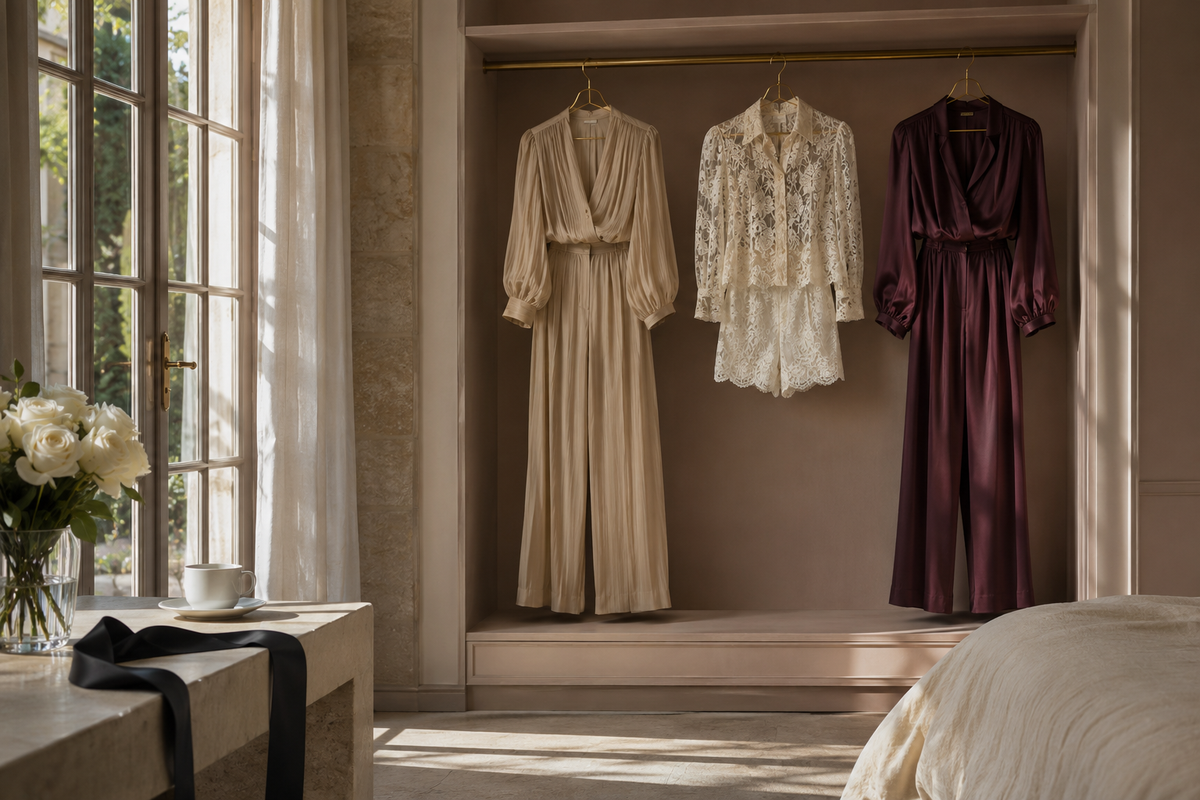
Article: How to Recognize Quality Lace: Five Details Worth Knowing

How to Recognize Quality Lace: Five Details Worth Knowing
How can you tell if lace is good quality? Quality lace is distinguished by five important details: clearly defined patterns, consistent threadwork, an appropriate balance of softness and structure, carefully finished edges and seams, and thoughtful lining and garment construction. The finest choice is not necessarily the most expensive or delicate lace, but the one whose design and performance suit the garment it is meant to become.
Not All Lace Is Created Equal
There is something inherently romantic about lace.
Perhaps it’s the intricacy of its patterns, the delicate spaces between threads, or the way light moves through a fabric that manages to feel both revealing and refined.
But beauty alone doesn’t tell us much about quality.
Two white lace blouses may appear nearly identical from a distance. Look closer, however, and the differences begin to emerge—in the definition of the flowers, the consistency of the threads, the way the fabric falls, and the care taken to finish its edges.
Understanding these differences allows us to appreciate lace beyond its appearance.
At GoodRib, we believe beautiful clothing should reward a closer look.
Here are five details worth knowing before choosing a lace garment.
1. Pattern Definition: Look Closely at the Motifs
The first thing to examine is the pattern itself.
Lace is distinguished by its openwork construction, often arranged into decorative motifs such as flowers, leaves, vines, or geometric shapes.
In well-executed lace, these details should appear intentional and clearly formed.
Look closely at a floral pattern.
Can you distinguish the petals from the surrounding leaves? Are the outlines clean? Do the decorative elements remain recognizable as the pattern repeats?
Sharp definition allows the design to retain its character, even when viewed from a distance.
Blurred motifs, uneven stitching, or unintended gaps may indicate inconsistent execution.
However, not every quality lace has a highly detailed pattern. Some of the most beautiful examples use simple, delicate designs.
What matters is clarity and consistency, not complexity alone.
What to look for: Clearly formed motifs, consistent pattern repeats, and decorative details that maintain their definition.
2. Threadwork: The Beauty Is in the Construction
Lace derives much of its character from the relationship between its decorative threads and open spaces.
Some varieties feature embroidered motifs on a fine net foundation. Others are constructed from interconnected threads without a continuous net background.
Neither method automatically determines quality.
What matters is how consistently the structure has been executed.
Examine the threads surrounding the motifs. Look for irregular loops, unintended loose ends, broken connections, or areas that appear noticeably different from the rest of the fabric.
A well-constructed lace should have an appropriate level of stability for its intended use.
The threadwork should support the pattern without creating unnecessary distortion.
This distinction is particularly important in clothing, where lace must do more than look beautiful while lying flat.
It must also accommodate the movement and construction of the garment.
What to look for: Even thread tension, secure connections, consistent motif construction, and an absence of visible damage.
3. Hand Feel and Drape: Softness Should Have a Purpose
One of the most common misconceptions about lace is that softer always means better.
In reality, the ideal hand feel depends on the garment.
A delicate lace blouse may benefit from a soft, fluid texture that allows it to move naturally against the body. A more structured lace garment may require additional firmness to maintain its silhouette.
Neither is inherently superior.
The more useful question is whether the fabric behaves as intended.
Does the lace fall naturally, or does it resist the shape of the garment? Does it feel comfortable against the skin? Does the material retain enough structure to support the design?
A fabric that feels overly rigid may be poorly suited to relaxed clothing, while one that lacks the necessary stability may lose its intended shape.
At GoodRib, this balance between softness and structure informs our approach to complete dressing.
The Devotion Lace Blouse, for example, is described with a soft hand feel and a gently structured, tailored silhouette designed to skim rather than cling to the body.
This pairing allows the lace to remain feminine without relying on excessive stiffness for its shape.
What to look for: A pleasing hand feel, appropriate flexibility, natural drape, and enough structural stability for the intended silhouette.
4. Edges and Seams: Where Craftsmanship Becomes Visible
The edges of a lace garment can reveal as much about its quality as the fabric itself.
Because lace is constructed with decorative openings, cutting and joining it requires particular attention.
A poorly managed edge may interrupt the pattern, leave loose threads, or create an unnecessarily bulky finish.
Well-considered construction, by contrast, respects the lace’s design.
Some lace fabrics feature natural decorative borders that can be incorporated into a garment’s hem or sleeve. Others require carefully finished cut edges.
Neither approach is automatically better.
What matters is that the finish suits the fabric.
Seams deserve equal attention.
Inspect how the pattern meets at the shoulders, side seams, and other construction points. Where practical, the motifs should appear thoughtfully placed rather than abruptly interrupted.
Perfect pattern matching is not always possible or necessary, particularly with complex lace designs, but careful placement contributes to the overall composition.
In refined garments, the construction should support the beauty of the fabric rather than compete with it.
What to look for: Cleanly finished edges, secure seams, controlled bulk, and thoughtful positioning of decorative motifs.
5. Lining and Closures: The Details That Complete the Garment
Quality lace is not judged by the decorative fabric alone.
The supporting elements matter just as much.
Because lace often incorporates areas of transparency, lining can determine how comfortably and confidently a garment is worn.
A carefully selected lining should provide appropriate coverage without unnecessarily compromising the lace’s drape or design.
Closures are equally important.
Buttons, plackets, waistbands, and other fastening details influence both the garment’s appearance and its functionality.
They should feel secure, sit neatly, and work naturally with the fabric surrounding them.
Consider the GoodRib Devotion Lace System.
The Devotion Lace Blouse is designed with a button-front closure and is accompanied by a white camisole, allowing the floral lace to retain its delicate transparency while offering a layering option.
Its coordinating Devotion Lace Short features a soft lining for coverage, a high-waisted silhouette, and a tailored belt.
These are not simply decorative decisions.
They help translate an intricate material into clothing intended for everyday use.
The lesson is simple: quality is not limited to what is visible on the surface. It also lives in the details that make a garment wearable.
What to look for: Appropriate coverage, smooth lining placement, secure closures, comfortable construction, and finishing that complements the lace.
The Devotion Lace System: Material Meets Intention
At GoodRib, the Devotion Lace System brings these considerations into a complete composition.
The blouse and shorts are made from coordinating intricate floral lace, allowing the design to read as one considered outfit rather than two unrelated garments.
The blouse combines a tailored silhouette with gentle structure, while its accompanying camisole provides an additional styling layer.
The coordinating shorts offer a high-waisted fit, soft lining, and a tailored belt.
Together, the pieces represent GoodRib’s approach to complete dressing: individual garments designed in relation to one another.
The lace contributes femininity and texture. The silhouette contributes composure. The finishing details contribute everyday wearability.
The result is a more considered approach to loungewear—one that recognizes that comfort and refinement can belong in the same wardrobe.
Explore the Devotion Lace Blouse
Discover the Devotion Lace Short
A Founder’s Perspective: Why the Details Matter
I’ve always believed that beautiful clothing should give a woman something beyond a beautiful reflection.
It should allow her to move through her day feeling comfortable, considered, and entirely herself.
That belief shapes the way I think about materials.
Lace is often reserved for occasions. We associate it with weddings, celebrations, and moments when we make a special effort to dress beautifully.
But I’ve never believed that femininity should be reserved for extraordinary days.
Why shouldn’t a woman enjoy beautiful lace on an ordinary morning at home?
Of course, making that possible requires more than selecting an attractive fabric.
The silhouette must make sense. The coverage must be considered. The pieces must feel as if they belong together.
For me, that’s where design becomes meaningful.
Beautiful materials catch our attention. Thoughtful construction gives them a place in our lives.
— Founder, GoodRib
Is Expensive Lace Always Better?
Not necessarily.
Price alone cannot establish lace quality.
The cost of lace may reflect its fibers, construction method, pattern complexity, finishing, manufacturing process, or origin. Brand positioning and distribution costs can also affect its retail price.
Likewise, synthetic lace is not automatically inferior to natural-fiber lace.
Polyester and nylon can be suitable choices for certain garments, just as cotton and silk may be preferable for others.
The most useful evaluation considers the fabric’s composition, construction, intended use, and how the finished garment performs.
A lace fabric should be judged according to what it is designed to do.
The Most Important Detail Is the One You Can Feel
Lace has always possessed an extraordinary ability to communicate femininity.
But its lasting appeal isn’t found in ornament alone.
It is found in the balance of pattern and proportion, delicacy and stability, decoration and thoughtful construction.
The next time you examine a lace garment, look beyond the flowers.
Notice the threads. Study the edges. Consider how the fabric moves. Pay attention to the pieces you don’t immediately see.
These details reveal a great deal about how a garment was made—and how carefully it was considered.
At GoodRib, we believe the everyday deserves that kind of attention.
Because good design is never just about how something looks. It’s about how beautifully it belongs in your life.
GoodRib. Designed to belong together.